In the earliest stages of a startup or small business, no-code automation platforms like Zapier, Make, and Zapier Tables are fantastic tools. They allow non-technical operators to stitch together a Google Sheet, a Stripe checkout, and an email tool in thirty minutes.
However, as a company scales past $2M+ in revenue and processes thousands of orders, customer updates, and inventory transactions each week, no-code integrations evolve from an agile shortcut into a fragile, expensive operational bottleneck.
1. Hitting the "Zapier Ceiling": Where No-Code Breaks Down
Businesses usually discover they have hit the Zapier ceiling when they experience three classic failure modes:
- Silent Data Drops: If an endpoint returns an unexpected 429 Rate Limit or 502 Bad Gateway error, no-code tools often silently fail or pause the workflow, causing orders or invoices to vanish without an engineering alert.
- Lack of Version Control: There is no Git repository, pull request workflow, or staging environment. An accidental click by an administrator inside a Zap configuration instantly impacts production data.
- Exploding Task Costs: When a business scales to 200,000+ monthly task executions, no-code platform bills can skyrocket to $800–$2,000+ every single month for basic data forwarding.
2. Architecture Comparison: No-Code GUI vs. Bespoke Microservices
Here is how production-grade custom integration middleware compares to no-code tools:
• Latency: 50ms – 150ms execution times (vs. 5–15 minute polling intervals).
• Security: Credentials stored in AWS Secrets Manager or Infisical, zero third-party data snooping.
• Testing: Automated unit and integration tests run on every code push.
• Observability: Structured JSON logging to Datadog or Sentry with real-time Slack/PagerDuty alerts.
3. Designing for Failure: Dead-Letter Queues & Idempotency
Distributed systems will inevitably experience network partitions and third-party SaaS downtime. In a custom integration, we handle this through Redis-backed job queues (such as BullMQ):
// Example BullMQ Queue Worker with Exponential Backoff
import { Worker, Queue } from 'bullmq';

export const crmSyncQueue = new Queue('crm-sync', { connection: redisConfig });

const worker = new Worker('crm-sync', async (job) => {
  const { eventId, customerData } = job.data;

  // 1. Enforce Idempotency
  const alreadyProcessed = await redisClient.get(`processed:${eventId}`);
  if (alreadyProcessed) return { status: 'skipped_duplicate' };

  // 2. Transmit to Destination CRM API
  await destinationCRM.syncCustomer(customerData);

  // 3. Mark Processed with 7-day TTL
  await redisClient.set(`processed:${eventId}`, 'true', 'EX', 60 * 60 * 24 * 7);
}, {
  connection: redisConfig,
  attempts: 5,
  backoff: { type: 'exponential', delay: 2000 }
});
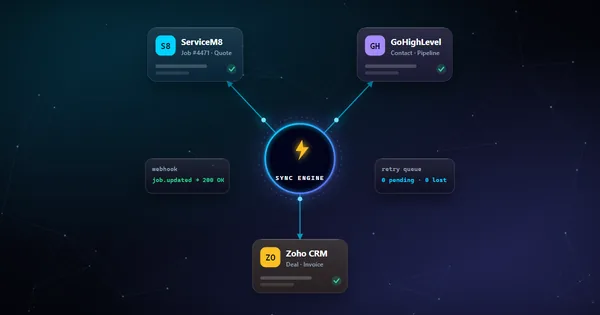
If the destination CRM is down for 30 minutes for maintenance, no data is dropped. The queue retries with exponential backoff and safely delivers each payload once the target recovers.
4. Bridging Legacy On-Prem SQL to Modern SaaS Webhooks
Many established industrial and service businesses operate on legacy SQL Server, Oracle, or on-premise ERPs that cannot fire modern HTTP webhooks.
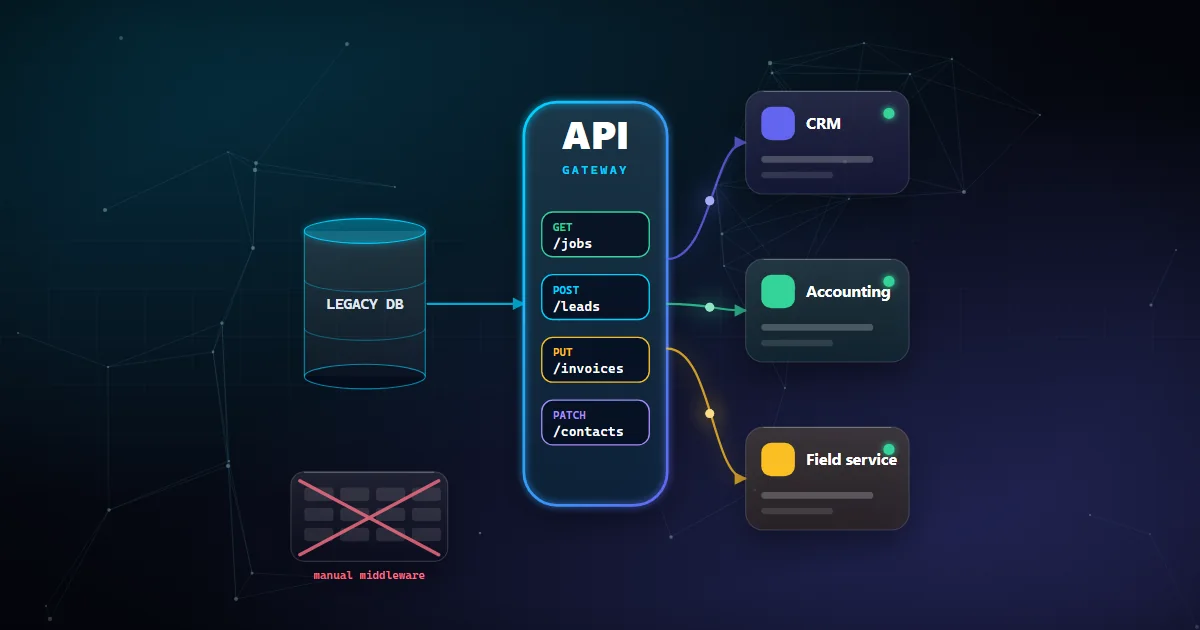
We build lightweight Change Data Capture (CDC) daemons that securely read database WAL (Write-Ahead Logs) or change tracking tables, transform the mutations into standardized JSON events, and securely publish them to modern cloud CRMs and analytics lakes via outbound HTTPS.
5. The True Total Cost of Ownership (TCO) Calculation
A dedicated custom integration microservice typically costs between $4,000 and $10,000 to design, build, and deploy. Hosting it on serverless AWS Lambda or a small Docker container costs less than $20/month.
Compared to paying $1,200/month for no-code enterprise tiers—plus dozens of hours of lost executive time troubleshooting broken zaps—a custom integration achieves complete ROI within the first 6 to 9 months and scales indefinitely.