For electrical contractors, plumbers, HVAC technicians, cleaners, and mobile service businesses, ServiceM8 is undeniably one of the best platforms for job dispatch, on-site technician scheduling, quoting, and field invoices.
However, ServiceM8 is not designed to be a full-scale inbound marketing and sales funnel CRM. For lead qualification, landing pages, multi-channel SMS nurturing, pipeline tracking, and customer retention campaigns, modern businesses and marketing agencies rely on GoHighLevel (GHL) or Zoho CRM.
1. The Disconnect: ServiceM8 Field App vs. Marketing CRM
When these platforms operate in silos, a severe operational bottleneck is created:
- A prospective customer submits an inquiry on your website or responds to a Facebook ad in GoHighLevel.
- The office manager must manually copy the client's name, phone number, address, and job notes into ServiceM8 to create a job card.
- The technician completes the job on-site in ServiceM8 and records payment, but the marketing CRM never learns that the job is finished.
2. Why Manual Double-Entry Destroys Agency & Contractor Margins
This manual handoff leads directly to revenue leakage:
- Lead Latency: New inquiries sit unassigned for 3 to 6 hours before being converted to a ServiceM8 job.
- Duplicate Records: Field staff create duplicate client profiles with slight variations in spelling or phone numbers.
- Cold Review Requests: Because nobody manually triggers review follow-ups on the same day, review requests are sent days later—resulting in abysmal review conversion rates.
3. The Real-Time Event-Driven Architecture Blueprint
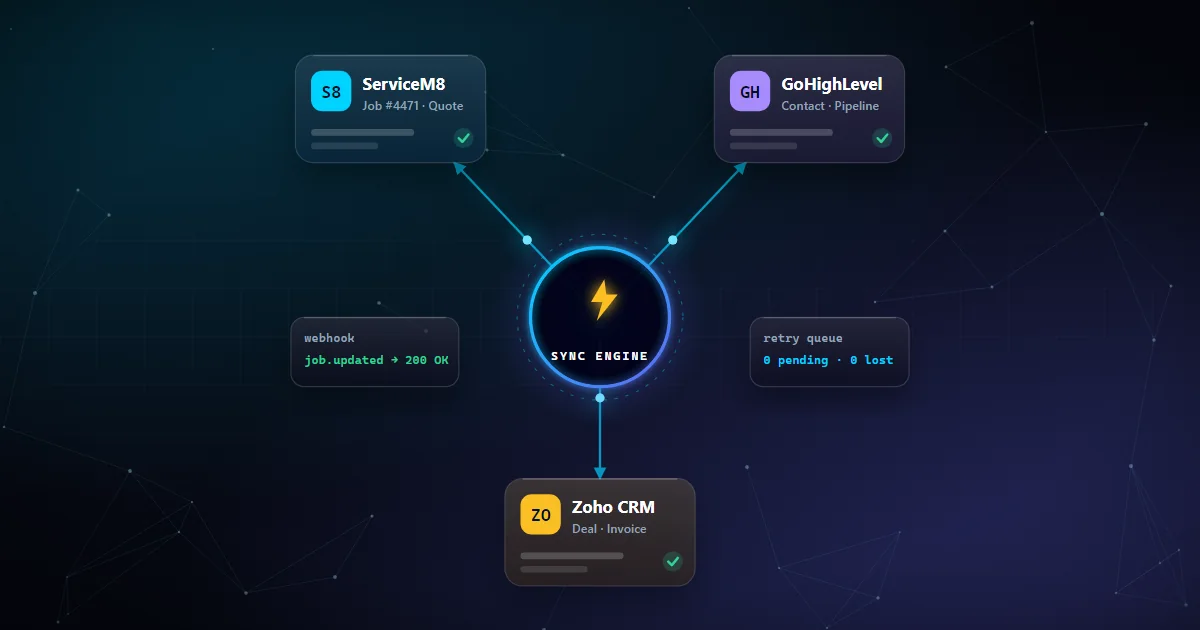
At StackandCode, we engineered an application bridge that provides seamless, bi-directional synchronization between ServiceM8 and any target CRM:
4. Implementation: Webhook Ingestion & Idempotency
The core requirement for production stability is idempotency. If ServiceM8 sends duplicate webhook retries due to a temporary network blip, the connector must ensure duplicate CRM contacts or opportunities are never created.
// Production Node.js Webhook Receiver with Redis Deduplication
import express from 'express';
import Redis from 'ioredis';

const app = express();
const redis = new Redis(process.env.REDIS_URL);

app.post('/webhooks/servicem8', express.json(), async (req, res) => {
  const { event, entry } = req.body;
  const idempotencyKey = `sm8:${entry.uuid}:${event}`;

  // 1. Guard against duplicate webhook deliveries
  const isDuplicate = await redis.set(idempotencyKey, '1', 'EX', 86400, 'NX');
  if (!isDuplicate) {
    return res.status(200).json({ status: 'duplicate_ignored' });
  }

  // 2. Dispatch to async worker queue
  if (event === 'job.status.changed' && entry.status === 'Completed') {
    await jobQueue.add('sync-completed-job', {
      jobId: entry.uuid,
      companyId: entry.company_uuid,
      totalAmount: entry.total_invoice_amount,
      completedAt: new Date().toISOString()
    });
  }

  res.status(200).send('ACK');
});
5. The Ultimate ROI: Automated 5-Star Review Generation
The most lucrative feature enabled by this integration is instant review capture.
When a technician in the field taps "Complete Job" in their ServiceM8 mobile app, the StackandCode bridge receives the webhook, verifies the client profile in GoHighLevel, advances the opportunity stage to "Job Completed", and triggers an automated SMS:
Clients report a 3.2x increase in Google 5-star reviews within the first 60 days of deployment simply by automating this critical post-service window.