Open almost any software agency's portfolio, and you'll see the exact same story: a showcase of frontend mockups, a list of programming languages (React, Node.js, Python), and promises of "clean code."
Yet when you look behind the scenes at the companies hiring them, their day-to-day operations are completely overwhelmed. Employees spend 15 to 25 hours every week copying data across disconnected dashboards, customer inquiries wait half a day for a human response, and leads drop off before anyone can schedule an intake call.
At StackandCode, we rejected that conventional approach from day one. We operate under a different fundamental premise: We don't build software for the sake of code. We engineer systems that solve operational bottlenecks.
1. The Fatal Flaw in Traditional Software Development
Most software engineering shops treat software as a static, isolated asset. They wait for a specification document, code the exact user interface described, verify that the database queries pass unit tests, and declare victory.
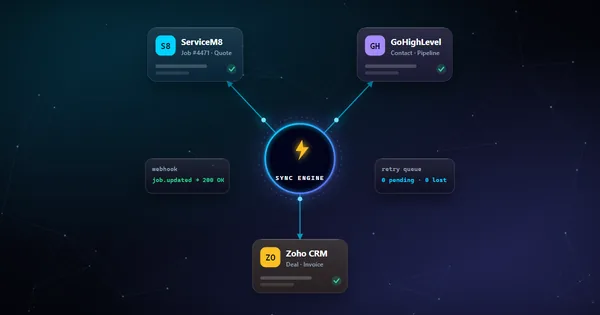
But software does not exist in a vacuum. If your web application doesn't synchronize seamlessly with your field service dispatch software (like ServiceM8), if sales reps must manually re-enter customer data into GoHighLevel or Zoho CRM, or if inquiries sit unanswered outside office hours, the software has failed to deliver business leverage.
2. What Does a "System That Thinks" Actually Mean?
A system that thinks is not a vague marketing buzzword or a generic AI chatbot bolted onto an existing website. It represents an active, event-driven operational loop with three defining characteristics:
- Continuous Awareness: The system listens to business triggers in real time—inbound lead submissions, job completion updates from technicians, payment receipts, or customer support tickets.
- Deterministic Decision Logic: Instead of waiting for a person to triage or route an issue, the system validates the payload, applies business rules, and leverages LLMs with structured outputs to score intent and determine the optimal next action.
- Autonomous Execution: The system acts immediately—dispatching notifications, synchronizing CRM pipelines, booking calendar slots, generating formatted documents, or alerting the right team member with full context.
3. The 3 Architectural Pillars of Intelligent Systems
Pillar I: Connected Infrastructure Over Siloed Apps
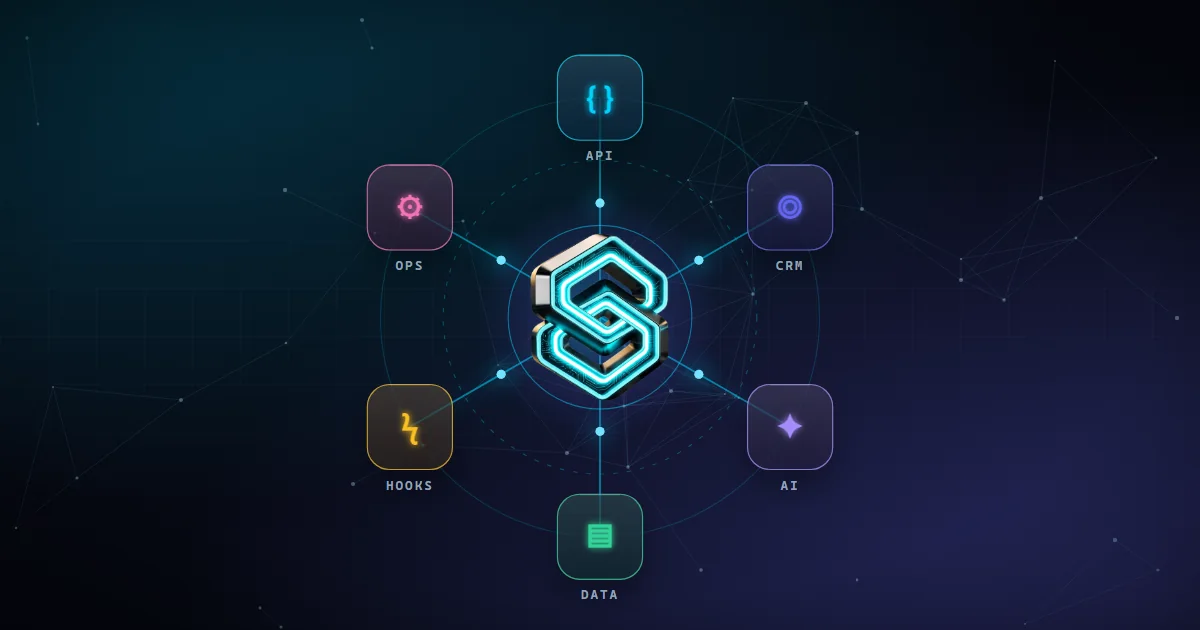
Every modern company already uses between 4 and 12 distinct software tools: email suites, field dispatch software, CRMs, accounting ledgers, and internal databases. Rather than attempting to replace everything with a bloated monolithic ERP, an intelligent system connects these platforms through custom event middleware, webhooks, and Redis message queues.
Pillar II: Embedded Artificial Intelligence
We treat AI as an infrastructure component, not a novelty. Whether it is:
- Retrieval-Augmented Generation (RAG): Grounding LLM responses in proprietary enterprise manuals and contract PDFs with zero hallucinations.
- Conversational Booking Agents: Engaging prospects over 24/7 SMS and WhatsApp to qualify budget and book appointments directly into Cal.com / GHL Calendar.
- Document Intelligence: Automatically parsing incoming invoices, customer complaints, and work orders to trigger the appropriate back-office workflow.
Pillar III: Hybrid Operational Delivery
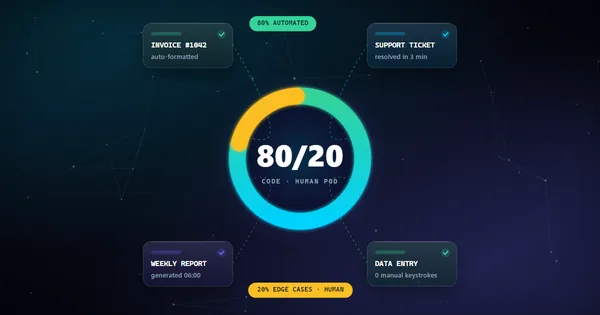
High-scale operations require closing the loop between technology and business execution. Where software automates the heavy lifting, dedicated managed operations ensure high-touch quality—from document styling to complex customer issue resolution.
4. Real-World Case: The Field-Service to CRM Automation Loop
Consider a field service contractor managing 25 technicians on ServiceM8 while their sales and marketing engine runs on GoHighLevel.
In a traditional setup:
- A technician completes a repair job on-site in ServiceM8.
- The invoice sits in ServiceM8 until the office manager reviews it two days later.
- The customer is never asked for a Google Review until memories have faded, and the marketing CRM has no record of the completed transaction.
In a system that thinks engineered by StackandCode:
// Event-driven real-time execution flow
ServiceM8 Job Completed Event (Webhook)
  ├──> Redis Event Queue (Validation & Idempotency)
  ├──> GoHighLevel Deal Stage Updated to "Completed"
  ├──> Automated 5-Star SMS Review Request Sent (within 10 minutes)
  └──> Accounting Ledger Sync & Next Preventive Service Reminder Scheduled
Zero manual data entry. Zero delays. Maximum customer satisfaction and automated business growth.
5. Moving from Manual Effort to Architectural Scale
When you stop trying to solve business bottlenecks by hiring more people to perform repetitive manual tasks, and instead invest in systems engineered around your specific operational flow, everything changes. Your response times drop from hours to seconds, human errors vanish, and your business runs on intelligence, not effort.