Generative AI and Large Language Models (LLMs) like Claude 3.5 Sonnet and GPT-4o possess encyclopedic knowledge of public internet data and exceptional reasoning skills. However, they know nothing about your company's internal customer contracts, private engineering documentation, proprietary pricing tables, or updated compliance SOPs.
When organizations attempt to ask foundation models questions about their internal systems, the models hallucinate answers with supreme confidence. Retrieval-Augmented Generation (RAG) has emerged as the definitive enterprise architecture to solve this problem.
1. The Core LLM Limitation: Stale Knowledge & Hallucinations
Foundation models are static artifacts. Their knowledge cutoff is fixed at their training time, and retraining them costs millions of dollars. Even more critically:
- You cannot safely paste internal client NDAs or medical records into public training pools.
- Regulatory compliance (such as GDPR right-to-erasure) cannot be guaranteed if customer data is baked into model weights.
- Without verifiable citations, employees cannot trust whether an AI-generated technical policy or quotation is accurate.
2. RAG vs. Fine-Tuning: Deciding the Right Architecture
A widespread misconception is that fine-tuning an LLM is the best way to teach it your private company documentation. Here is how they actually compare:
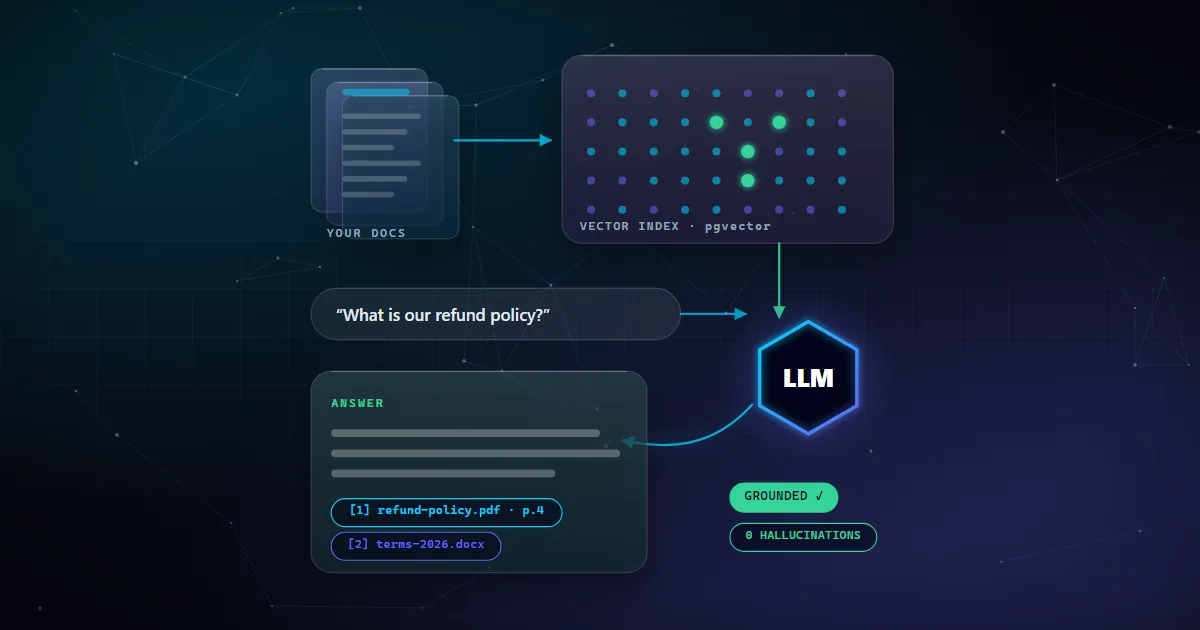
RAG (Retrieval-Augmented Generation): Acts like an "open-book exam." The system searches your private documents for relevant paragraphs, retrieves them, and feeds them into the prompt window alongside the user's question with explicit source links.
3. How an Enterprise RAG Pipeline Actually Works
A production-ready RAG architecture consists of two primary loops:
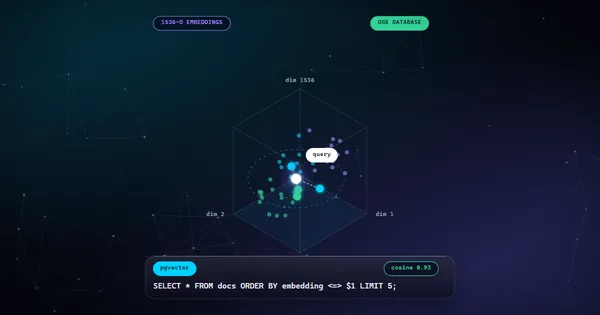
- Ingestion & Vectorization: PDFs, Notion workspaces, Google Docs, and SQL tables are parsed, cleaned, and split into semantic chunks (typically 400–800 tokens). Each chunk is converted into high-dimensional vector embeddings and stored in a vector index.
- Query & Generation: When a user asks a question, the query is embedded, the system retrieves the top-K most semantically relevant text chunks, applies re-ranking, and constructs a grounded prompt instructing the LLM to answer using only the retrieved evidence.
4. Why Naive RAG Fails in Production
Many teams build a quick LangChain demo in a weekend and assume it is ready for production. Then users submit real queries and complaints flood in:
- Chunk Fragmentation: Splitting text strictly by character count cuts sentences in half, severing subject-object relationships.
- Lack of Keyword Precision: Dense vector search struggles with exact SKU numbers, legal clause numbers, or serial IDs. Solution: Hybrid Search combining vector similarity with BM25 keyword search.
- Missing Re-ranking: Vector similarity alone frequently ranks tangentially related paragraphs above the exact answer. Adding a Cohere or Cross-Encoder re-ranker stage solves this.
5. When Does Your Business Truly Need RAG?
Your organization is a prime candidate for a custom RAG deployment if:
- Your customer support team spends 30%+ of their time searching internal wikis or manuals to answer recurring inquiries.
- You have large volumes of PDF manuals, clinical guidelines, or legal contracts that require fast, cited search.
- You want to power an internal AI research assistant that respects role-based access control (RBAC) so junior employees cannot retrieve executive compensation files.